
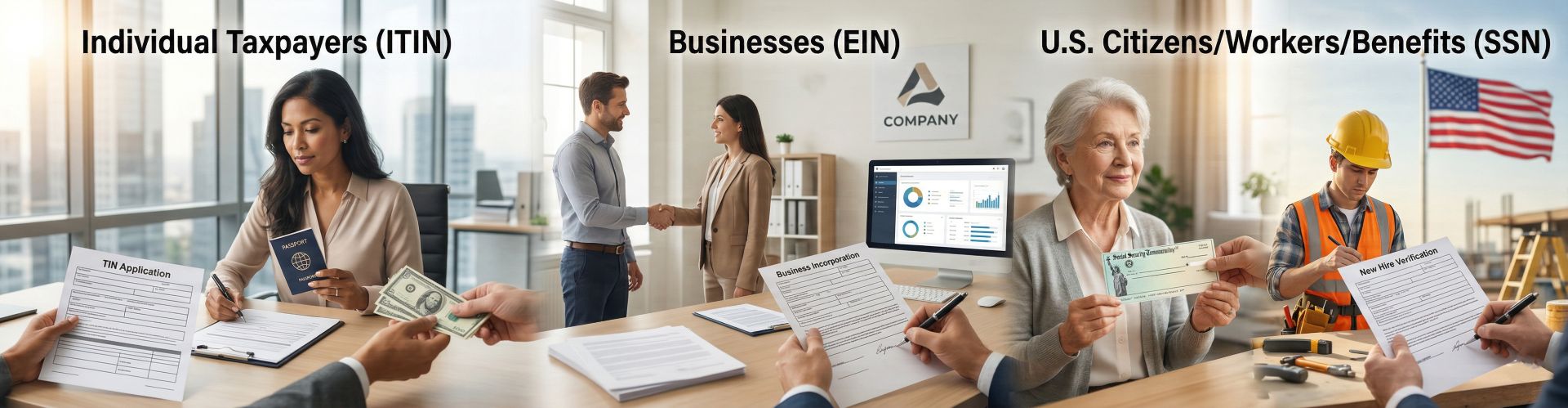
The United States uses three main tax identification numbers: Social Security Numbers for citizens and authorized workers, Individual Taxpayer Identification Numbers for those ineligible for SSNs, and Employer Identification Numbers for businesses. Understanding which number you need depends on your citizenship status, work authorization, and whether you operate a business.
| Tax ID Type | Who Needs It | Primary Use | Work Authorization |
|---|---|---|---|
| SSN | U.S. citizens, permanent residents, and authorized workers | Personal taxes, employment, and benefits | Yes |
| ITIN | Foreign nationals with tax obligations, no SSN eligibility | Personal tax filing only | No |
| EIN | Businesses, employers, trusts, and estates | Business taxes, hiring employees | N/A |
The IRS created different identification numbers to serve different taxpayer categories. Each number tracks tax obligations for specific groups of people or entities. This system prevents confusion and maintains proper tax records.
According to the IRS Taxpayer Identification Numbers guide, each type serves distinct purposes. The separation ensures accurate tax processing and protects taxpayer information. Different agencies handle different identification numbers based on their areas of responsibility.
The Social Security Administration issues SSNs while the IRS issues ITINs and EINs. This division of labor creates efficiency in the system. Understanding these differences helps you choose correctly for your situation.
A Social Security Number identifies U.S. citizens and authorized workers throughout their entire lives. The nine-digit number never expires and serves multiple purposes beyond just taxation. SSNs enable employment verification, benefit eligibility, and credit reporting.
An Individual Taxpayer Identification Number helps people file taxes when they cannot get SSNs. The IRS issues ITINs only for federal tax purposes and nothing else. These numbers do not provide work authorization or change immigration status.
An Employer Identification Number identifies business entities for tax purposes. Businesses need EINs to hire employees, file business tax returns, and open business bank accounts. Research from the Tax Policy Center shows millions use these numbers annually.

ITINs serve foreign nationals who must file U.S. taxes but cannot obtain Social Security Numbers. The nine-digit number begins with 9 and follows the format 9XX-XX-XXXX. The IRS created ITINs in 1996 to help people comply with tax laws.
ITINs work only for federal tax filing and reporting purposes. They do not provide work authorization under any circumstances. Immigration status does not affect ITIN eligibility or issuance.
ITINs expire after three years without use on tax returns. Regular filing every three years keeps the number active indefinitely. Renewal follows the same process as initial applications.
The number helps people claim refunds for overwithheld taxes. Certain tax credits become available to ITIN holders with qualifying dependents. However, ITINs do not qualify holders for Social Security benefits or Medicare coverage.
Nonresident aliens earning U.S. income need ITINs for tax reporting purposes. Students on F and J visas often require these numbers for scholarship and fellowship income. Teaching assistants at universities also need ITINs for stipend reporting.
Spouses and dependents of U.S. taxpayers may need ITINs to be claimed on returns. Foreign nationals starting U.S. businesses without SSN eligibility require ITINs for personal tax filing. Independent contractors working remotely for U.S. companies also need these numbers.
Real estate investors earning rental income from U.S. properties must obtain ITINs. Foreign nationals receiving prize money or lottery winnings in the U.S. need ITINs. Anyone with U.S. tax obligations who cannot get an SSN qualifies for ITIN issuance.

Employer Identification Numbers work like Social Security Numbers, but for businesses instead of individuals. The IRS issues these nine-digit numbers to identify business entities for tax purposes. The format is XX-XXXXXXX and never begins with 9.
Businesses need EINs to hire employees and pay employment taxes. The number enables business bank account opening and credit building. Many vendors and clients require EINs before establishing business relationships.
EINs remain with businesses through ownership changes and restructuring. The number does not expire unless the business formally dissolves. Applications are free, and processing is usually immediate online.
Sole proprietors without employees may use their SSNs instead of EINs. However, getting an EIN provides privacy protection for personal Social Security Numbers. Most tax advisors recommend obtaining separate business identification.
Corporations, partnerships, and LLCs with multiple members must have EINs. Any business hiring employees needs an EIN regardless of business structure. Businesses withholding taxes on non-wage payments also require these numbers.
Sole proprietors with employees need EINs for payroll tax purposes. Trusts and estates filing tax returns require EINs for proper identification. Certain retirement plans and tax-exempt organizations also need business identification numbers.
Foreign businesses operating in the U.S. need EINs for tax compliance. International business owners can apply without SSNs or ITINs. The IRS accepts third-party designee information for foreign applicants.

Social Security Numbers serve as primary identification for U.S. citizens and authorized workers. The nine-digit numbers are formatted as XXX-XX-XXXX without starting with 9. The Social Security Administration issues these numbers at birth or upon immigration.
SSNs enable legal employment throughout the United States. Employers verify work authorization through these numbers during the hiring process. The numbers also track earnings for Social Security benefit calculations.
These numbers never expire and remain with individuals for their entire lives. SSNs serve multiple purposes beyond tax filing and employment verification. Credit bureaus, banks, and government agencies all use SSN verification systems.
The number provides access to various government benefits and programs. Social Security retirement, disability, and survivor benefits depend on SSN records. Medicare enrollment also requires a valid Social Security Number.
U.S. citizens receive Social Security Numbers automatically at birth or upon naturalization. Parents receive the cards by mail within weeks of birth registration. Permanent residents obtain SSNs as part of the immigration process.
Students with on-campus employment authorization qualify for Social Security Numbers. Certain visa holders with work permits also receive SSNs from the Social Security Administration. The agency verifies immigration status before issuing numbers.
Anyone eligible for an SSN should obtain one instead of an ITIN. The SSN provides broader benefits and more opportunities for financial growth. Converting from an ITIN to an SSN happens automatically when eligibility changes.
| Feature | ITIN | EIN | SSN |
|---|---|---|---|
| Issued By | IRS | IRS | Social Security Administration |
| Format | 9XX-XX-XXXX | XX-XXXXXXX | XXX-XX-XXXX |
| For Individuals | Yes | No | Yes |
| For Businesses | No | Yes | Limited |
| Work Authorization | No | N/A | Yes |
| Expires | After 3 years of non-use | No | No |
| Social Security Benefits | No | N/A | Yes |
| Hire Employees | No | Yes | No |
| File Personal Taxes | Yes | No | Yes |
| File Business Taxes | No | Yes | Limited |
START: What describes your situation?
Are you a U.S. citizen or permanent resident?
│
├─ YES → Use Social Security Number (SSN)
│
└─ NO → Do you have work authorization?
│
├─ YES → Apply for SSN
│
└─ NO → Are you operating a business?
│
├─ YES → Get EIN for business + ITIN for personal taxes
│
└─ NO → Do you have tax filing obligations?
│
├─ YES → Apply for ITIN
│
└─ NO → No tax ID needed now
Foreign students on F-1 visas typically need ITINs for tax filing purposes. Their visa type prevents Social Security Number eligibility in most cases, except for authorized on-campus work. Scholarships, fellowships, and research stipends create taxable income requiring proper reporting.
Business owners who are U.S. citizens use SSNs for personal taxes and EINs for business. The separation protects personal information and simplifies accounting procedures. Using both numbers correctly prevents confusion during tax season.
Foreign nationals starting U.S. businesses need both EINs and ITINs for complete compliance. The EIN identifies the business entity for business tax returns. The ITIN identifies the owner personally for individual tax filing.
Authorized workers with valid work permits should always get Social Security Numbers. The SSN provides maximum benefits and opportunities for career growth. Never use an ITIN if you qualify for an SSN.
Spouses of U.S. citizens who cannot work legally still need ITINs for joint filing. Filing jointly often provides better tax rates and higher standard deductions. The ITIN enables this filing status even without work authorization.
Complete IRS Form W-7 and gather required documentation proving identity and foreign status. Original documents or certified copies from issuing agencies must accompany applications. Attach a valid federal tax return unless you qualify for a specific exception.
Submit applications by mail to the IRS address listed in Form W-7 instructions. Apply in person at IRS Taxpayer Assistance Centers with an appointment. Work with Certifying Acceptance Agents to verify documents without mailing originals.
Processing takes seven to eleven weeks, depending on timing. Peak season, from January through April, experiences longer delays. Apply early to avoid tax filing deadline problems.
Apply online through the IRS website for instant EIN assignment during business hours. Complete Form SS-4, providing business information and the responsible party details. International applicants can call the IRS international line or mail applications.
The online application takes about fifteen minutes to complete. You receive your EIN immediately upon approval and can print confirmation. No supporting documents are required, and the process is completely free.
U.S.-born citizens receive Social Security Numbers automatically at birth through hospital registration. Naturalized citizens apply during the citizenship process. Immigrants with work authorization apply at Social Security Administration offices in person.
Bring immigration documents, work authorization papers, and identity verification. Processing takes two to four weeks for most applications.
Using ITIN When Eligible for SSN - Always apply for a Social Security Number if you qualify. Never choose an ITIN over an available SSN.
Applying for Wrong Business Number - Determine if you need an EIN before applying. Using your SSN may work for simple sole proprietorships.
Mixing Personal and Business Numbers - Keep personal tax identification separate from business identification. Mixing numbers creates tax filing confusion.
Forgetting ITIN Renewal - ITINs expire after three years without use on tax returns. Track your ITIN expiration date carefully.
Not Updating After Status Change - Notify the IRS when your status changes from ITIN to SSN eligibility. Keep both agencies informed of changes.
Do I need an ITIN if I have an EIN?
Yes, if you are a foreign business owner filing personal taxes. The EIN identifies your business, while the ITIN identifies you personally.
Which US TIN should I use, SSN or ITIN?
Always use your SSN if you have one or are eligible for one. Use ITINs only when you cannot get an SSN.
Do I need a tax ID and an EIN?
Yes, if you run a business and file personal taxes. Your personal tax ID and business EIN serve separate purposes.
Is an ITIN the same as an EIN?
No, ITINs identify individual taxpayers while EINs identify business entities. They cannot substitute for each other.
Can I apply for an EIN without an SSN or ITIN?
Yes, foreign business owners can get EINs without personal tax IDs. Personal identification is not required for business numbers.
Do you need both a TIN and an EIN?
Yes, if you operate a business and file personal taxes. Both are necessary for complete tax compliance.
Can I use my SSN instead of a tax ID?
Your SSN is a type of tax ID. Sole proprietors without employees can use SSNs for business.
Is my tax ID the same as my EIN?
Only if you are a business entity. Individuals use SSNs or ITINs as tax IDs.
Does an LLC need an EIN or TIN?
LLCs with multiple members or employees must have EINs. Most advisors recommend getting EINs regardless.
Who cannot get an EIN?
Anyone can get an EIN for a legitimate business purpose. Even individuals without a U.S. presence can obtain EINs.
Can a non-US citizen get an EIN?
Yes, foreign nationals can get EINs for U.S. business operations. No U.S. citizenship or residency is required.
Can I use my EIN to get an apartment?
No, EINs are for business purposes only. Landlords require personal identification like SSNs or ITINs.
Choosing the right tax identification number can feel confusing with multiple options and requirements. Easy Tax Store helps you determine which numbers you need.
As an IRS-certified Certifying Acceptance Agent, we simplify ITIN applications while protecting your documents. We also provide guidance on EIN applications.
Contact us to discuss your tax identification needs.
Get the right tax identification today to stay compliant with U.S. tax laws.