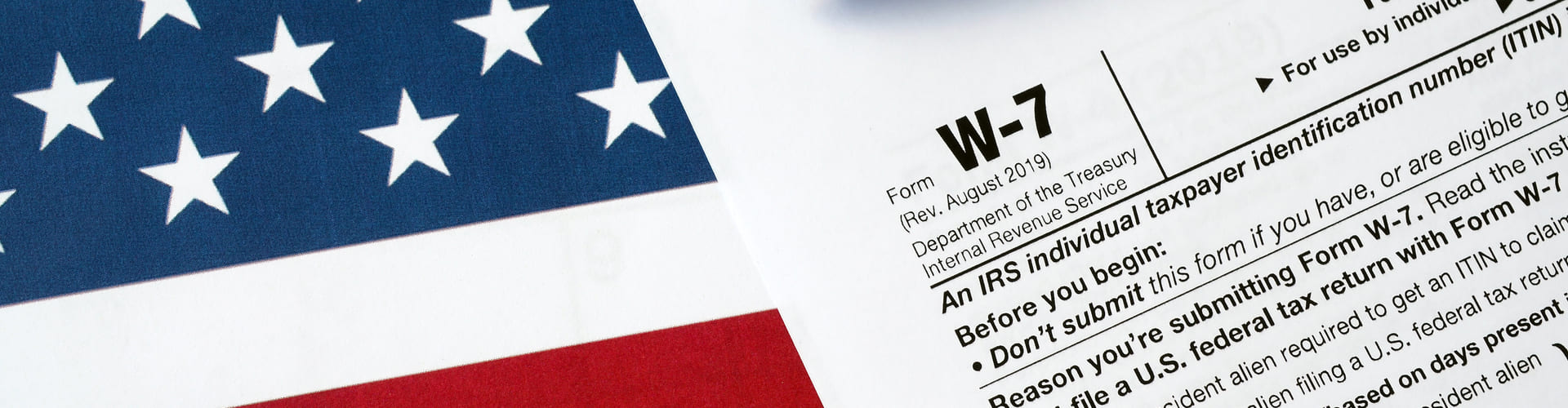
Required Documents for ITIN Application: ID and Status Checklist
Individual Taxpayer Identification Number (ITIN) applications require careful preparation of identification documents. Whether you’re applying for a new ITIN or renewing an expiring one, the IRS needs to verify two things about you: your identity and your foreign status. Gathering the right documents—and sending them in the correct form—can make the difference between a smooth ITIN approval and a frustrating delay. This checklist will walk you through:
- Which documents are commonly accepted for ITIN (Form W-7) applications.
- The best document choices for different situations (main applicant, spouse, child, international student).
- The rules about original documents vs. certified copies (and how to avoid mailing your passport).
- Common mistakes to avoid so your ITIN application isn’t rejected over paperwork issues.
If you’re not yet familiar with the ITIN application process itself, be sure to follow our step-by-step guide on how to apply for an ITIN (see our detailed ITIN application guide on our website) for the full process. And if your ITIN has expired, you’ll need to renew your ITIN before filing a tax return (see our ITIN renewal guidance to avoid delays). For a primer on what an ITIN is and who needs one, you can also read our introduction to ITINs on Easy Tax Store. Now, let’s dive into the document requirements so you can prepare your ITIN application with confidence.
What the IRS Wants to See: Identity and Foreign Status
When you apply for an ITIN, the IRS must confirm two key points: your identity (proving who you are) and your foreign status (proving you’re not eligible for a U.S. Social Security Number). In simple terms, the documents you send with Form W-7 need to show your name, photograph (for most applicants), and date of birth, as well as evidence of your citizenship or residence outside the United States.
- Identity proof: A document that shows your personal identity details, typically including your full name and a photo. Examples are passports, driver’s licenses, and national ID cards.
- Foreign status proof: A document that shows you are a foreign national or nonresident. This could be indicated by your citizenship on a passport or national ID, or documents like a foreign birth certificate or foreign voter registration card.
Some documents can satisfy both requirements at once – the most notable being a passport, which serves as proof of both identity and foreign status in one go. According to the IRS, “a passport is the only stand-alone document” that by itself covers everything needed. Other documents might cover only identity or only foreign status, in which case you’ll need to submit a combination of two documents (one from each category). Form W-7 and its instructions list exactly which documents are acceptable. In the next sections, we’ll outline the most common acceptable documents and how they are used to meet these requirements.
Most Common Documents Used for ITIN Applications
The IRS accepts 13 types of documents to establish identity and foreign status for an ITIN application. If you have a valid passport, that’s usually the simplest solution, since a passport alone proves both identity and foreign status. If you don’t have a passport, you must provide two documents: one to prove identity (with a photo ID) and one to prove foreign status. (At least one of the two documents must have a photo, unless the applicant is a young child.) Below is a summary of commonly used ITIN documents, what they prove, and typical use cases:
| Document Type |
Proves Identity? |
Proves Foreign Status? |
Common Use Case |
| Passport |
Yes ✔ |
Yes ✔ |
Best single document for most applicants (adults and children). |
| National ID Card (foreign) |
Yes ✔ |
Yes ✔ * |
Often used by foreign citizens without a passport (must show photo, name, DOB, address, and expiration date). |
| U.S. or Foreign Driver’s License |
Yes ✔ |
No ✖ |
Supplementary identity proof (e.g. if no passport, a foreign license doesn’t by itself prove foreign status). |
| U.S. State ID Card |
Yes ✔ |
No ✖ |
Supplementary identity proof (for residents who need an ITIN, e.g. state non-driver ID). |
| Birth Certificate (civil birth record) |
Yes ✔ (DOB) |
Yes ✔ * |
Common for proving identity of dependents (especially children); if foreign, also proves foreign status. |
| U.S. Visa (in foreign passport) |
Yes ✔ |
No ✖ |
Often used alongside a foreign ID to add a photo ID; visa by itself is U.S.-issued (identity only). |
| Foreign Voter Registration Card |
Yes ✔ |
Yes ✔ * |
Can serve as identity and foreign status proof (less common, depends on country’s ID info). |
| Foreign Military ID |
Yes ✔ |
Yes ✔ * |
Acceptable for identity and foreign status (for military family applicants). |
| U.S. Military ID |
Yes ✔ |
No ✖ |
Identity proof (usually for spouses/dependents in military families, alongside other docs). |
| USCIS Photo ID |
Yes ✔ |
No ✖ |
Identity proof (issued by U.S. immigration authorities, e.g. work permit card, doesn’t confer foreign status by itself). |
| Medical Records (dependents under 6) |
Yes ✔ |
Yes ✔ * |
For young children — can establish identity (name/DOB) and, if foreign, status. If used to show U.S. residency, must have U.S. address. |
| School Records (dependents under 18 if a student, under 24 in some cases) |
Yes ✔ |
Yes ✔ * |
For older children/teens — shows identity (name/DOB) and potentially foreign status if from foreign school. U.S. school records can prove U.S. residency for certain credits. |
*(In the IRS’s rules, a document can count as proof of foreign status only if it is a foreign (non-U.S.) document. For example, a foreign birth certificate or foreign ID card shows you have a connection to a foreign country, whereas a U.S. driver’s license does not.)
Passport
A valid passport is by far the most straightforward document for an ITIN application. It’s the only document that the IRS accepts as a stand-alone proof, meaning if you submit your passport (original or certified copy), you don’t need any other identity or status documents. A passport provides your photo, date of birth, and personal details (establishing identity) and also indicates your country of citizenship (establishing foreign status).
For most adult applicants and many dependents, using a passport makes the ITIN process simpler. We always recommend:, “the best and easiest option is submitting a valid passport, which serves as proof of both identity and foreign status.” If the passport is unexpired and has all the necessary information, the IRS will accept it as full documentation.
Dependent note: If you’re applying for an ITIN for a child or dependent, the passport should have a date-of-entry stamp if the child has ever entered the U.S. This is important because a passport with a U.S. entry date can double as proof of U.S. residency for certain tax benefits. If a dependent’s passport does not have a U.S. entry date (for example, the child has never been to the U.S.), the IRS will require an additional document to prove the child’s U.S. residency, such as a U.S. medical or school record. (We’ll discuss proof of U.S. residency for dependents more in a later section.)
National Identification Card
A national ID card (from your home country) is another document the IRS accepts, provided it meets certain criteria. The card must show: your name, your photograph, your date of birth, your current address, and an expiration date. Common examples include government-issued identity cards, citizen ID cards, or similar documents used in many countries.
A national ID can serve as an identity document and often indicates your nationality or residence, so it may count toward proving foreign status as well. However, since requirements and information on national IDs vary by country, you might still need to pair it with another document. For instance, if your national ID doesn’t clearly show your foreign citizenship or if the IRS needs more, you could include a birth certificate or foreign voter card as additional proof of foreign status.
Many applicants use a national ID card in combination with another document when they don’t have a passport. For example, you might send a national ID card + foreign birth certificate together – one provides photo identity, the other emphasizes foreign status. Always ensure your national ID is current (not expired) at the time you submit your Form W-7; an expired ID will be rejected.
Birth Certificate
A civil birth certificate is particularly useful (and sometimes required) for ITIN applications for children or dependents. A birth certificate shows the person’s name, date of birth, and place of birth. By itself, a birth certificate is a strong proof of identity for a minor’s application (since young children often don’t have photo IDs yet). If the birth certificate was issued in a foreign country, it also serves as evidence of foreign status.
In fact, current IRS rules state that if a dependent under age 18 does not have a passport, an original birth certificate is required with the ITIN application. So, if you’re applying for an ITIN for a child and you aren’t submitting the child’s passport, make sure to include the birth certificate.
Keep in mind that a birth certificate does not contain a photo. Therefore, if it’s used as one of the two documents (in the absence of a passport), the other document should have a photograph of the applicant (for example, a school ID card, a state ID, or in the case of an adult without passport, maybe a driver’s license). The birth certificate primarily covers identity (name and birth date) and establishes foreign status only if it’s a foreign birth record.
Driver’s License or State ID
A driver’s license (whether U.S. or foreign) and a U.S. state identification card are also on the IRS list of acceptable documents, but these serve only as proof of identity. A license shows your name, photo, date of birth, and usually address, which satisfies the identity verification component. However, a U.S.-issued driver’s license or state ID does not indicate foreign status at all, and a foreign driver’s license, while it’s issued by another country, is generally considered an identity document rather than a primary proof of foreign status in the ITIN context.
Because of that, a driver’s license by itself isn’t enough for an ITIN application. It must be paired with another document that demonstrates your foreign status or ties to a foreign country. For example, if you’re an international student with a U.S. driver’s license, you might submit your license plus your foreign birth certificate or foreign ID card to cover both requirements.
For dependents, a U.S. state ID card or driver’s license can also be useful as a secondary document to prove U.S. residency if required (for instance, for a dependent in the U.S. who needs to show they live in the U.S. for certain tax credits). But generally, think of licenses and state IDs as supplemental ID proofs – you’ll need another document from the foreign status category to complete your application if you go this route.
Visa and Other Supporting Documents
Other documents that sometimes come into play include U.S. visa documents and records for dependents:
- A U.S. visa (typically a visa stamp in your passport) can be used as one form of identification. A visa has your photo and name, which helps prove identity. However, because a U.S. visa is issued by the U.S. Department of State, it doesn’t by itself prove “foreign status” – it actually confirms you were authorized to travel to the U.S. So a visa is usually paired with something like a foreign ID or birth certificate. For example, if you don’t have a passport, you might submit a national ID card + U.S. visa: one shows you’re a foreign national (national ID), and the visa adds a photo ID component. Note: If you do have a passport, the visa is unnecessary for the ITIN application (the passport is stronger on its own).
- Medical records and school records can be used for dependent applicants in specific age groups. A medical record (like vaccination or pediatric records) is acceptable for children under 6 years old, and a school record is acceptable for students under 18 years old (under 24 if the applicant is a full-time student). These documents must be official and show the child’s name and date of birth; if they’re being used to prove U.S. residency, they should show a U.S. address as well. Medical and school records are typically used in addition to a birth certificate or passport when applying for young children, especially if the child needs to show residency in the U.S. (for example, to claim the Child Tax Credit a dependent must have lived in the U.S. for part of the year).
- USCIS photo identification and military IDs: Less commonly, applicants might use an identification card issued by USCIS (U.S. Citizenship and Immigration Services) or a military ID. A USCIS photo ID could be something like a work authorization card. A U.S. military ID would apply only in certain cases (for example, a military spouse or dependent who can’t get an SSN might have a military ID). These are treated as identity documents. A foreign military ID can also be used and can serve as both identity and foreign status proof if applicable. Again, these are niche cases – most people will rely on passports, national IDs, or birth certificates, as those are more standard.
Tip: The IRS’s official list is exhaustive, but you do not need to submit more documents than necessary. Aim for the strongest proofs available for your situation. If you have a valid passport, that’s usually all you need. If not, choose two documents that together cover identity + foreign status. We’ve summarized common combinations here, but if you want to be sure, you can double-check the full list in the IRS Form W-7 instructions or the ITIN documentation page on IRS.gov.
Documents Needed by Applicant Type
Now let’s break down the typical documentation scenarios by applicant type. Different situations (applying for yourself as the primary taxpayer, for a spouse, or for a child dependent, etc.) might have slight differences in the best approach. The fundamental IRS requirements don’t change, but certain documents are more common in some cases than others. Use these as guidelines for what you’ll likely need:
Main Taxpayer (Adult Applicant)
If you are the primary applicant (for example, a non-U.S. resident who needs an ITIN for yourself to file a tax return), you should focus on the document(s) that best prove your own identity and foreign status.
- Passport is the top choice: If you have an unexpired passport from your country of citizenship, you can send that alone and satisfy all requirements. This is the simplest route. Make sure the passport is valid (not expired) on the date you sign your Form W-7; an expired passport will not be accepted.
- No passport? Use two documents: Many adult applicants who don’t have a passport will use a combination such as: foreign national ID card + birth certificate, or foreign ID card + U.S. visa, or foreign driver’s license + birth certificate. The key is one document that has a photo and proves identity, and another that shows a connection to your foreign country (place of birth or citizenship). For instance, a national ID card (with your photo) plus a foreign birth certificate (showing you were born outside the U.S.) together meet the criteria. Or, a foreign voter registration card plus a driver’s license could work – one shows nationality, the other has a photo. Always ensure at least one of the documents has a photo unless you’re exempt due to age (the photo requirement is waived for applicants under 14, or under 18 if a student).
- Examples:
• Foreign national living abroad – Passport (alone). If no passport: National ID card + birth certificate.
• Resident alien (filing as resident for tax) – If you have a state ID or driver’s license, you’d still need a foreign status doc: e.g. State ID + foreign birth certificate.
• Nonresident investor (never lived in U.S.) – Passport (alone). If passport unavailable: Foreign driver’s license + foreign voter card (one gives photo ID, the other evidences foreign citizenship).
In all cases, remember to send original documents or certified copies from the issuing agency (more on this shortly). Photocopies that are not properly certified will lead to rejection.
Spouse Applying for an ITIN
If you are applying for an ITIN for your spouse (for example, your spouse is a foreign citizen who needs an ITIN to be included on a joint U.S. tax return), the document requirements are essentially the same as for the primary applicant. The spouse will need to prove identity and foreign status just like any other applicant.
- A passport is ideal for a spouse ITIN application as well. For instance, a foreign spouse who is not eligible for a Social Security Number can often get an ITIN by submitting their passport with Form W-7 attached to the joint tax return. This covers everything in one document.
- If the spouse doesn’t have a passport, use two documents (one identity + one foreign status) exactly as described for the main applicant. Common choices include a national ID, visa, or driver’s license for identity, combined with a birth certificate or foreign ID for status.
- One thing to note: if you’re filing a joint tax return, you will attach your spouse’s Form W-7 and documents to the tax return. Ensure the name on the documents matches the name on the tax return and W-7 form. If your spouse’s name changed (e.g., after marriage), it’s important to use the correct name on Form W-7 and provide any necessary documentation of the name change. A common mistake is applying under a new married name without proof of the name change, which can cause confusion. The IRS will accept a marriage certificate or other legal name change document if the names don’t match, so include that if applicable.
Aside from that, spouses don’t have any special document requirements beyond what any adult would need. (Being a spouse is just the reason for needing the ITIN, not a different standard for identity proof.) For more detailed guidance on ITINs for spouses and dependents, you can refer to our resources on ITIN rules for family members on the Easy Tax Store site.
Child or Dependent Applying for an ITIN
Applying for an ITIN for a child or other dependent (for example, a foreign child who will be claimed on your U.S. tax return) has a few unique considerations. The IRS still needs to see identity and foreign status documents, but because dependents are often minors, the types of documents used can differ from an adult’s application:
- Passport (with entry stamp if in U.S.): If the child has a passport, this is the simplest solution. Submit the child’s passport (original or certified copy). As mentioned earlier, if the child lived in the U.S. at any point and the passport includes a U.S. entry date, the passport alone serves as identity, foreign status, and proof of U.S. residency. If the child’s passport has no entry stamp (meaning they haven’t been in the U.S.), you can still use the passport for identity/status, but additional proof of U.S. residency may be required if you’re claiming certain credits for the child. In such cases, you’d attach for example a U.S. medical or school record to show the child lived with you in the U.S..
- Birth certificate (required if no passport): For any dependent under 18 without a valid passport, the IRS requires an original birth certificate to be included. The birth certificate establishes the child’s identity (name and date of birth) and, since it’s a foreign birth certificate in most cases, it also indicates foreign status. This is non-negotiable: if you don’t include a birth certificate for a child with no passport, the application will be rejected.
- Other ID for the child: Because a birth certificate has no photo, you should pair it with another document that has a photo if the child is old enough. Children under 6 can use medical records as a second document, and children in school can use school records or a school ID card. These documents can show identity details and are often used to prove the child’s U.S. residency if needed. For example, a school record might show the child’s name, U.S. address, and dates of school attendance, which can satisfy the requirement to prove the child lived in the U.S. for part of the year (this is necessary for the Child Tax Credit or Credit for Other Dependents in many cases).
- Proof of relationship: While not a primary “W-7 document,” remember that if you are applying for a minor child’s ITIN, you will be attaching the child’s ITIN application to your tax return. The tax return will show your relationship to the child (son, daughter, etc.). In some cases, if the last names differ or the relationship isn’t obvious, it’s wise to include supporting documents like a birth certificate (which shows parent names) to prove the relationship. This isn’t an official ITIN document requirement, but it can help prevent delays when the IRS processes the tax return with the ITIN request.
Summary for dependents: Most commonly, a dependent ITIN application includes Passport (if available; plus another residency proof if no U.S. entry stamp) OR Birth Certificate + one or two of the following: a school record, medical record, or maybe a state ID (for a teenager). Also ensure the dependent meets the additional criteria if claiming a tax benefit (for instance, not all dependents outside the U.S. are eligible to be claimed for certain credits without living in the U.S., except those from Canada or Mexico have special rules).
For more in-depth discussion on ITINs for dependents (and rules for dependents from Canada, Mexico, or military families), see our dedicated guide on ITIN applications for spouses and dependents on our site. We cover scenarios like proving residency for dependents and which tax benefits require additional documents.
International Students and Scholars
International students, researchers, or scholars who need ITINs (typically because they’re on visas like F-1, J-1, etc., and receiving stipends or scholarships) should follow the same documentation rules, with a few extra pointers:
- Passport: Use your passport as the primary document if at all possible. As with others, a valid passport proves both identity and foreign status. Most students will have a passport from their home country—this is the gold standard document.
- Visa and immigration documents: In addition to your passport, you will have a U.S. visa (in your passport) and supporting immigration documents like the Form I-20 (for F-1 students) or Form DS-2019 (for J-1 exchange visitors). These documents prove your current status in the U.S. (e.g., student status) but are not required to be sent with the ITIN application in most cases. However, there are some instances where they might be needed: for example, if you’re applying for an ITIN under an exception (not attaching a tax return because you’re claiming a tax treaty benefit for a scholarship), you might have to include copies of your I-20/DS-2019 or a letter from your institution. That falls under “exception documentation” rather than the core ID documents.
- Combination documents if no passport: If an international student doesn’t want to send the passport (perhaps due to needing it for travel), they could use other IDs: a national ID card from home, a student ID card, or a driver’s license, in combination to meet identity and foreign status. For example, a student might submit a national ID card + U.S. visa copy (the national ID shows foreign identity, the visa has photo proving identity too). Note though, one of these must be a certified copy from the issuing agency if it’s not an original passport. Generally, most students do end up using their passport because universities often guide them to do so, or they use a certified acceptance agent to certify the passport so they don’t mail it (more on this soon).
- Check with your school’s international office: Many colleges and universities assist international students with ITIN applications (especially if the ITIN is needed for a scholarship tax treaty benefit). They might act as certifying acceptance agents (CAAs) or coordinate with the IRS so students don’t have to mail original passports. It’s a good idea to reach out to your school’s international student office or financial services office for guidance. They can often provide the Certificate of Accuracy (if they are a CAA) or direct you to a nearby IRS Taxpayer Assistance Center to verify your documents.
In summary, students and scholars should treat the ITIN document requirement just like any other adult applicant: passport is best; otherwise two forms of ID. Just be aware of the additional paperwork (I-20/DS-2019, etc.) that you might need to include for why you need the ITIN (but that’s separate from proving identity).
Original Documents vs. Certified Copies
One of the most confusing (and critical) parts of the ITIN application is the rule about original documents and certified copies. The IRS is very strict about not accepting plain photocopies of identity documents. Here’s what you need to know to ensure your documents are in the acceptable format:
- Original documents: This means the actual, physical document issued by the authority. For example, your actual passport book, your actual birth certificate, etc. When you send an “original,” the IRS will mail it back to you after processing your application. Understandably, many people are nervous about mailing important originals like a passport across the world. (The IRS does return originals by mail, typically within 11 weeks, but delays can happen.)
- Certified copy: A “certified copy” is a special copy of the original document that is made and certified by the issuing agency itself. It has an official stamped seal or certificate from the agency stating it’s a true copy of the original. For example, you can request a certified copy of your passport from the government office that issues passports, or a certified copy of a birth certificate from the civil registry or vital records office in the country of birth. Some foreign consulates or embassies offer services to certify a copy of your passport (essentially, they look at your passport and provide a certified duplicate). Important: A notarized copy is not the same as a certified copy, and the IRS will not accept notarized copies in most cases. A notary public simply witnesses a copy or signature; that’s not sufficient for IRS ITIN purposes (except for military dependents, where notarized copies are exceptionally allowed).
- What the IRS will reject: Any regular photocopy that is not certified by the issuing authority. For example, a photocopy of your passport that you made at home and got notarized will be rejected. The IRS explicitly says you must submit originals or copies certified by the agency that issued the document. One tax forum expert put it plainly: “Yes, the IRS requires either original documents or document copies certified by the issuing agency. They will reject an ITIN application with plain photocopies.” This is one of the most common reasons ITIN applications get delayed or denied.
So, what can you do if you don’t want to mail your original passport or ID to the IRS? Fortunately, there are options:
- Certified Acceptance Agents (CAAs): A CAA is a person or business (often tax preparers or accounting firms) authorized by the IRS to verify documents for ITIN applications. If you use a CAA, you can show them your original documents in person. The CAA will then send the IRS a Certificate of Accuracy (Form W-7 COA) along with copies of your documents, confirming they’ve seen the originals. This way, you keep your passport in hand. Easy Tax Store is a Certified Acceptance Agent (authorized by the IRS) – we can assist applicants by reviewing and certifying passports and other documents, so you don’t have to mail those originals to the IRS. (In fact, the Easy Tax Store team holds an IRS CAA license which allows us to file ITIN requests on behalf of clients without sending in their original passports.) If you’re worried about mailing your passport, contact us to learn how we can help verify your documents and handle the ITIN application process for you.
- IRS Taxpayer Assistance Centers (TACs): These are IRS offices in various cities where you can make an appointment to present your identification documents. An IRS officer can verify your passport or ID in person and return it to you immediately, and then they process the Form W-7 without you mailing the original. This service is free, but you might have to travel to a TAC location (and not all areas have one). If you’re applying from outside the U.S., TACs might not be an option unless you plan to visit the U.S. soon.
- Certified copies from agencies: As mentioned, you can obtain a certified copy of your passport from your country’s passport office or embassy. Many embassies will certify a copy for you if you explain it’s for U.S. tax purposes. Similarly, for a birth certificate, you can request an official duplicate (which is essentially a new original, since birth certificates don’t usually have “copies,” they just issue another original with official seal). Using certified copies means you can send those and keep your original safe at home.
In short, you have three ways to satisfy the IRS without losing your original documents in the mail: use a CAA, visit the IRS in person, or obtain certified duplicates to mail. Never send just a plain photocopy – it will cause your application to be rejected or delayed. The IRS even notes that a common mistake is “sending a notarized copy instead of a certified copy from the issuing authority.”
Also, ensure your documents are up-to-date. An expired ID is treated as invalid. The IRS only accepts current, unexpired documents. For example, a passport must be valid (not beyond its expiration date) on the date you sign and submit the W-7. A national ID card or driver’s license must likewise be unexpired. Always double-check expiration dates and renew any ID if needed before using it for your ITIN application.
Common Document Mistakes That Delay ITIN Applications
To wrap up the document section, let’s quickly run through some common mistakes related to documentation that you should avoid. These pitfalls have caused many ITIN applications to be rejected or delayed, but they’re entirely preventable:
- Sending photocopies that are not certified: As stressed above, regular copies or even notarized copies of passports/IDs are not accepted. If you mail in anything other than an original or properly certified copy, the IRS will likely reject the application. How to avoid: Use a CAA or get certified copies from the issuing agency, or send originals if you’re comfortable (they will be returned by the IRS). Do not assume a notarized copy is okay – for ITIN, it’s not (with very limited exceptions).
- Using expired or non-approved documents: Submitting an expired ID or a document that isn’t on the IRS’s list of 13 accepted types will lead to trouble. The IRS explicitly says only certain documents count. For example, a municipal ID card or a library card, no matter how official-looking, is not acceptable. How to avoid: Check the expiration dates and the official IRS list. “The IRS only accepts 13 specific types of identification… If your document isn’t on that list, your application will be rejected.” Make sure at least one of your documents has a photo (unless the age exception applies).
- Names not matching or proof of name change missing: If the name on your documents is different from the name you put on Form W-7 (or the name on the tax return), the IRS could get hung up verifying your identity. A common scenario is a married person who changed their last name – their passport might be in the maiden name but the tax return has the married name. How to avoid: Wherever possible, use consistent naming. If there’s a difference, include a copy of the marriage certificate or legal name change document as a supporting item. That way, the IRS can connect the dots. As one source notes, applying under a new married name without proof of the name change is a known mistake that can cause delays.
- Missing a required document for dependents: This is a frequent issue for those applying for children. For example, not including a birth certificate for a child under 18 with no passport, or not providing a document to prove U.S. residency for a dependent when it’s needed for a tax credit. How to avoid: Always include an original birth certificate for under-18 dependents who don’t have passports. And if you’re claiming a dependent for a tax benefit that requires U.S. residency, include that school record, medical record, or entry stamp proof. If the dependent’s passport lacks a U.S. entry date, remember you must add a residency document for certain credits. Don’t assume the IRS will process it later – they will likely send a notice asking for more info, which slows everything down.
- Documents not meeting IRS specifications: This is a catch-all, but examples include: a national ID card that doesn’t have an expiration date or address (hence not meeting IRS criteria), a school record that isn’t signed by a school official or doesn’t have a date, or documents that aren’t translated (if not in English, the IRS may require a translation). How to avoid: Use documents that clearly have all required info (for instance, if one ID is incomplete, use a different one or an additional one that fills the gap). For foreign-language documents, consider including an official translation (especially for vital records). The IRS Form W-7 instructions provide details on such requirements; when in doubt, refer to those or consult a tax professional or acceptance agent.
By double-checking these issues before you send your ITIN application, you can save yourself from the common headaches. It’s all about providing exactly what the IRS needs, in the format they require. If you’re unsure about anything, feel free to reach out to our Easy Tax Store team for guidance – as ITIN specialists and a CAA, we’ve seen all these scenarios and can help you navigate them so your application is correct the first time.
FAQs About ITIN Application Documents
Here are some frequently asked questions related to the documents for an ITIN application, along with quick answers:
- Is a passport enough to apply for an ITIN?
Yes – a valid, unexpired passport (original or certified copy) is enough in most cases. A passport is the only single document that proves both your identity and your foreign status for an ITIN. If you submit your passport, you generally do not need to submit any other identification documents. However, there are a couple of nuances: For dependent children, a passport should include a date of entry into the U.S. to serve as proof of U.S. residency if you’re claiming certain tax credits. If the passport has no U.S. entry stamp and the child needs to prove residency, you’d attach an additional residency document (like a medical or school record) along with the passport. But for the basic ITIN requirements of identity and foreign status, a passport alone suffices for any applicant (adult or child).
- Can I send photocopies instead of original documents?
No, the IRS will not accept regular photocopies. Your documents must be either originals or copies certified by the issuing agency. Plain copies (even if notarized by a notary public) will be rejected in most cases. The only exception is for dependents of U.S. military personnel stationed overseas, where notarized copies are allowed, but for everyone else, it’s originals or agency-certified copies only. If you’re uncomfortable mailing originals, consider using a Certified Acceptance Agent or visiting an IRS office to have documents verified in person (this way you keep your originals). Remember, an IRS-authorized CAA can review your original passport/ID and send in certified copies on your behalf, which is a safe alternative to sending your actual passport.
- How do I get a certified copy of my passport or birth certificate?
To get a certified copy, you must contact the agency that issued the document. For a passport, that might be the passport office or authority in the country that issued your passport (often, embassies and consulates can provide this service for passports). For a birth certificate, you would request an official copy from the government office (civil registry or vital records department) in the country or state where you were born. The certified copy will typically have an official seal and a statement that it’s a true copy of the original. Tip: Many embassies offer to certify passports for ITIN purposes if you make an appointment. Also, note that Easy Tax Store, as a CAA, can certify your passport and birth certificate for the IRS – essentially, we prepare a Certificate of Accuracy that tells the IRS we’ve seen the originals. This is another convenient route to avoid dealing directly with foreign agencies. Lastly, if time and resources permit, you could also apply for a second passport (some countries allow multiple passports) or use your country’s passport renewal system to get a duplicate – but usually a certified copy is easier.
- What documents do I need to get an ITIN for my child?
For a child dependent, the documents are usually: Passport (if the child has one) or Birth Certificate (if no passport, this is required) plus additional documents like medical or school records. A birth certificate will prove the child’s identity (and foreign status if foreign birth). If the child is very young (under 6), a pediatrician’s record or immunization record can serve as the second document. If the child is school-aged, a school record (report card, school transcript, or a letter from the school) can serve as the second document. These records should ideally show the child’s name, date of birth, and U.S. address if you need to prove U.S. residency. Also remember, if you’re claiming a child who lives abroad, certain tax benefits (like the Child Tax Credit) generally require the child to live with you in the U.S. — except for children of residents of Canada or Mexico or military—so ensure you understand those rules. In summary: Passport alone is best; if no passport, Birth Certificate + Medical/School record; and include proof of U.S. residency if required for your situation.
- Do I need different documents if I live outside the United States?
No, the list of acceptable documents is the same worldwide. Whether you’re applying from inside the U.S. or abroad, the IRS’s requirements for proving identity and foreign status do not change. You’ll still need either a passport or two qualifying documents from the list. The main difference when you live outside the U.S. is how you submit your application. Since you likely can’t visit an IRS office easily, you will either have to mail your originals or certified copies to the IRS in the U.S., or find a local Acceptance Agent (some accounting firms or U.S. embassies/consulates may assist). For example, if you’re in Europe or Asia, you might work with a CAA who will handle the documents so you don’t mail your passport overseas. But the documents themselves – passport, national ID, etc. – are the same. Just plan for longer mailing times and use a secure courier if mailing internationally. One more consideration: if you’re abroad and applying for a dependent’s ITIN for U.S. tax credits, be mindful of the U.S. residency proof rules (most foreign residents can’t claim the child tax credit unless the child lived in the U.S. with them for over half the year, except citizens of Canada or Mexico in certain cases). The IRS will ask for proof of U.S. residency for dependents in those cases, and if you’re entirely outside the U.S., you may not be eligible for those credits in the first place.
- Are digital copies or scanned documents accepted for ITIN applications?
No, simply printing a digital scan of your document is not acceptable unless that scan is accompanied by a proper certification. The IRS does not accept documents by email or digital upload for ITINs – everything is paper-based. If you have an electronic copy of, say, a birth certificate, you can’t just print it and send it as a “certified” copy. It must have come from the issuing agency with a certification. That said, some records like electronic bank statements, utility bills, or electronic school records are considered original if you print them out, but those are typically for proving residency (not identity for ITIN). For identity documents like passports and IDs, you need hard-copy originals or certified copies. A scanned color copy of your passport that you print out is just a photocopy – not valid by itself. If you work through a CAA, the CAA will make copies and attach their certificate; those copies are then effectively “validated.” But if you’re on your own, don’t send scans. In short: digital or emailed copies = not accepted. Always provide physical originals or certified copies for the ITIN application.
Applying for an ITIN can seem daunting because of these strict document requirements, but it’s all about proving who you are in a reliable way. By using the checklist above and ensuring your documents are in order, you’ll greatly improve your chances of a quick approval. Always refer to the latest IRS Form W-7 instructions for any updates (rules can change, though the core document list has been stable for years). And remember, you don’t have to go it alone – Easy Tax Store is here to help. As an IRS-authorized Certified Acceptance Agent, we can guide you through the ITIN application process, certify your documents, and submit your application correctly. If you have any doubts about which documents to use or how to prepare them, contact us for assistance. Getting your ITIN is the first step to staying compliant with U.S. tax laws, and with the right documents in hand, you’ll be on your way to a successful application!
To apply for an ITIN, you have to provide the following documents:
-
- Copy of your passport in color (it has to be valid at least 6 months)
- Completed application form (PDF)
- Signed Power of Attorney (PDF)
- Copy of your visa (if any)
The rest of the required documentation depends on your reason for applying for the ITIN number.
To check which documentation you need, feel free to contact us.
Completed and scanned documentation you can forward to:
- Email to: easytaxstore@gmail.com
- Or you can send by post or bring in person to Maksima Gorkog 3/4, 21000 Novi Sad, Serbia.